Community
The ARK Alliance community comprises institutions and people who use or assign ARK identifiers as well as those interested in promoting ARKs and sustaining the open ARK infrastructure, which consists of standards, best practices, the N2T.net resolver, and the registry of ARK organizations. There are also working groups (Outreach, Technical, NAAN Registry, Advisory) and an Archival Resource Key Community Code of Conduct.
 |
|---|
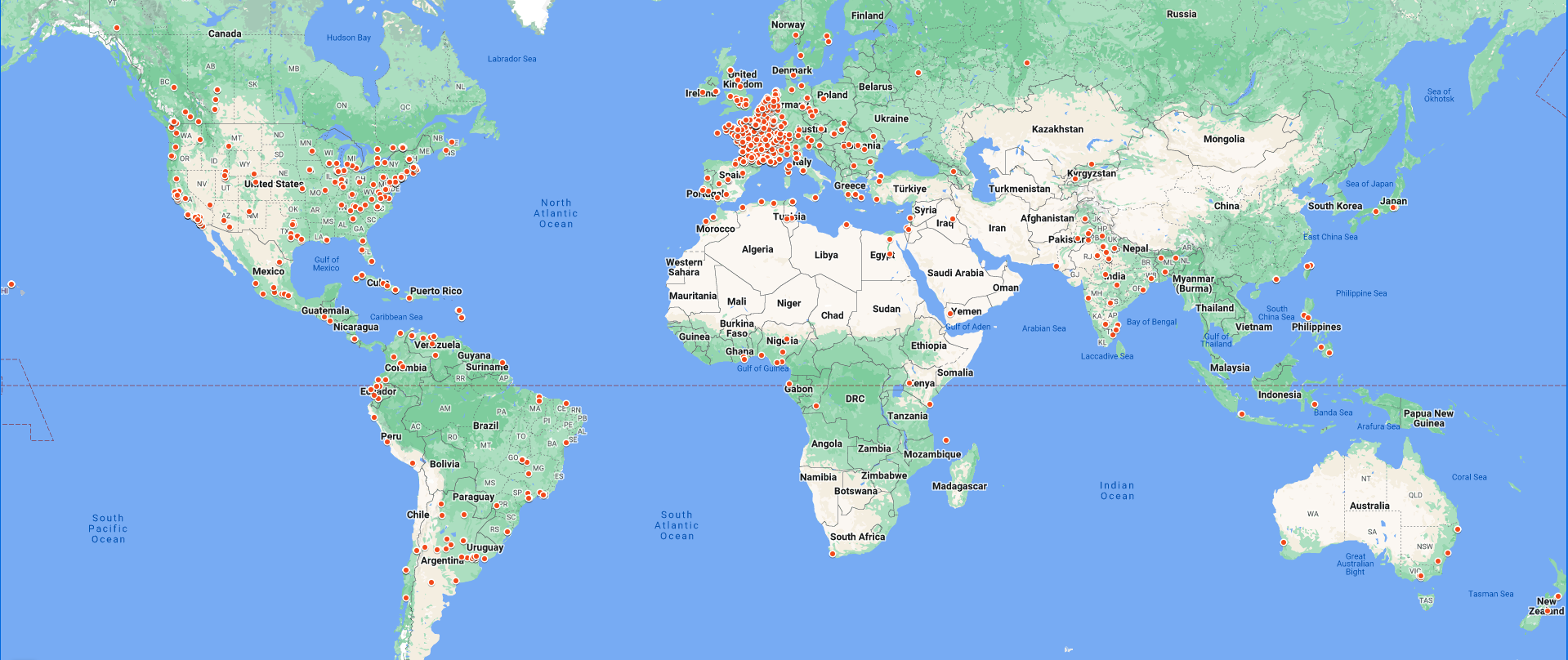
| Global distribution of over 1700 ARK organizations. |
The ARK Alliance emerged from a collaboration between the California Digital Library and DuraSpace/LYRASIS. Launched in 2018, it has gained the support of 47 institutions listed further below. Since 2021 the ARK Alliance has been a member of the NDSA, an international consortium committed to the long-term preservation of digital information.
How to get involved
- Join an ARK discussion forum
- Follow the ARK Alliance on mastodon @arks_org@fosstodon.org
- Follow us on Bluesky @arks_org.bsky.social
- Read the ARK Alliance blog
- Sign up for our newsletter
- Submit a community news item or blog post using this online news form; you can use this story template to help create your content
- Tell us about yourself by filling out a 5-minute ARK survey (in English) or 🇫🇷 une enquête ARK (version française)
- Tell us about your interest in helping with the work of the ARK Alliance
- Contact us about joining one of the working groups
Who is creating ARKs
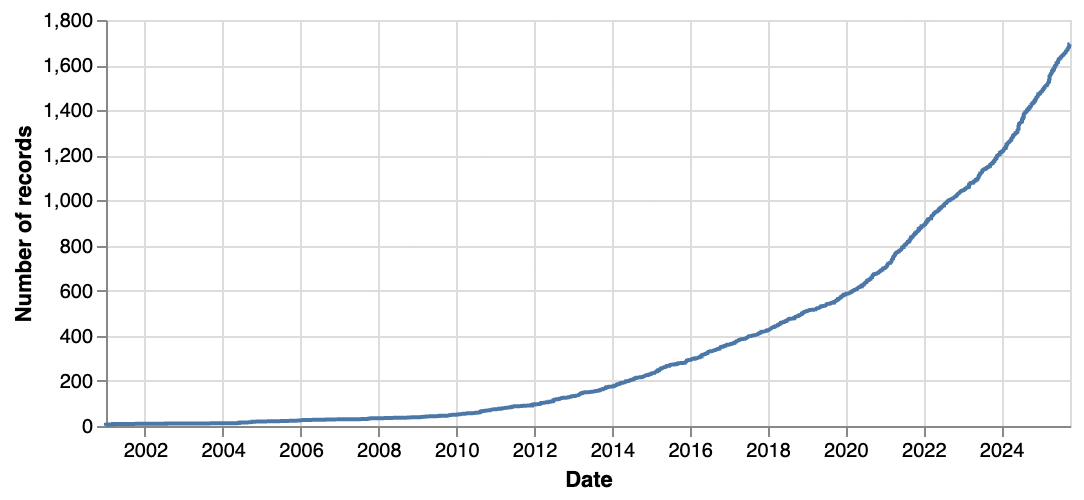
Since 2001 over 1700 organizations across the world registered to assign ARKs. As of late 2025, the registry includes 13 national libraries, 215 universities, 254 archives, 144 museums, 124 journals, and 59 scientific centers, as well as many other organization types (government agencies, vendors, research labs, etc). To register your organization, fill out this online request form.
What ARKs are being assigned to (February 2023):
- genealogical records (15 billion FamilySearch)
- publisher content (157 million Portico)
- scanned texts (50 million Internet Archive)
- scientific records (22 million INIST)
- bibliographic records (27 million BnF main catalog)
- museum specimens (15 million going on 100 million Smithsonian)
- public health documents, many from legal discovery (20 million UCSF IDL)
- digitized documents and objects (36 million CDL, 6 million BnF Gallica)
- historical persons, families, and organizations (4 million SNACC)
- finding aids and special collections (4 million Merritt)
- library and archival objects (1.3 million Durham University Library)
- educational resources (1.1 million University of Utah)
- fine art (490,000 Louvre museum)
- historic maps (334,000 Princeton University Libraries)
- vocabulary terms (30,000 Periodo, YAMZ)
- datasets, journals, archeological artifacts, living beings, etc.
We continue to receive expressions of interest and have attracted support from the following 47 institutions on 4 continents:
- Africa PID Alliance
- Australian National Data Service
- Bibliothèque et Archives nationales du Québec
- Bibliothèque nationale de France
- Bibliothèque nationale de Luxembourg
- The British Library
- Caltech (California Institute of Technology)
- City University of New York
- Colectica
- Consejo Nacional de Investigaciones Científicas y Técnicas – Argentina
- Crossref
- DaSCH, Swiss National Data & Service Center for the Humanities
- DeSci Labs
- Editorial Mar Caribe
- ENIP – Universidad Autónoma de Nayarit
- Family Search International
- HES-SO University of Applied Sciences and Arts, Haute école de gestion de Genève
- Indiana University
- Institut Internationale de la Marionnette
- Institute of Information Science, Academia Sinica, Taiwan
- Internet Archive
- Max Planck Institute for Art History – Bibliotheca Hertziana
- National Center for Atmospheric Research
- National University of Ireland, Galway
- Penn State University
- Portico
- Sempiternelia
- Service interministériel des Archives de France
- Smithsonian Institution
- South China Institute of Frontier Science
- Texas A&M University Libraries
- Texas Advanced Computing Center (TACC)
- University College Dublin
- University of Arizona
- University of California, San Francisco
- University of Chicago
- University of Houston Libraries
- University of Illinois at Chicago
- University of Illinois at Urbana-Champaign
- University of Maryland
- University of North Texas
- University of Pennsylvania Libraries
- University of Southern California Information Sciences Institute
- University of Utah
- University of Virginia
- West and Central African Research and Education Network (WACREN)
- Zürcher Hochschule der Künste